Based on our professional carbon black technology, CSRC is constantly pursuing product innovation. Based on our core concepts and principles, our most important green products are “New LH Series Carbon Black” and “Non-Toxic Carbon Black Series” as well as “Eco-circular Carbon Black.”
CSRC is actively developing "New LH Series Carbon Black" with high rigidity, low rolling resistance, good thermal aging resistance, and buckling resistance characteristics. These features enhance tire durability and performance for tire manufacturers and facilitate excellent results on tire label. Through practical testing, tires manufactured using the "New LH Series Carbon Black (Continex-LH ™ )" show optimized rolling resistance and improved tread wear resistance, in turn reducing vehicle fuel consumption and carbon emissions. According to EU statistics, comprehensive adoption of energy-efficient tires for vehicles across the EU could annually reduce carbon dioxide emissions by 4 million tons, equivalent to removing 1.3 million passenger cars from EU roads each year. CSRC's R&D Center in the United States has obtained relevant patents, including applications for passenger car tire treads and truck tire treads, and will initiate laboratoryscale trials.
Excellent tires must adhere to the "Devil's Triangle Law," encompassing rolling resistance (RR), wet traction (WT), and wear resistance (WR). The new LH Series Carbon Black (Continex-LH ™ ) exhibits significant superiority in rolling resistance (RR) and wear resistance (WR).
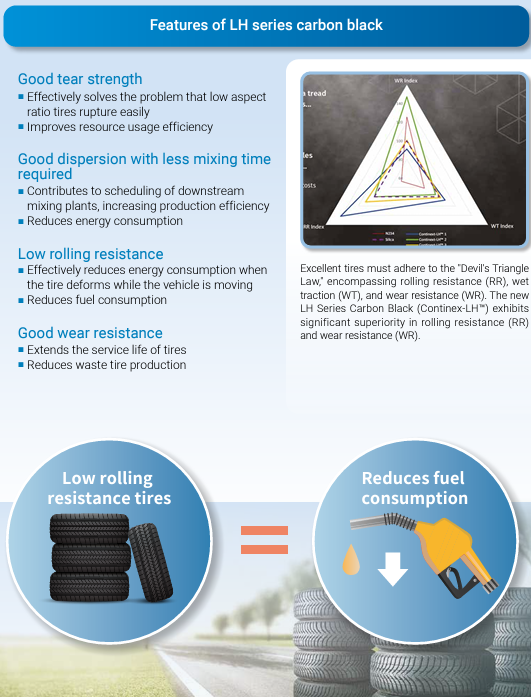

- Effectively solves the problem that low aspect ratio tires rupture easily
- Improves resource usage efficiency
- Contributes to scheduling of downstream mixing plants, increasing production efficiency
- Reduces energy consumption
- Effectively reduces energy consumption when the tire deforms while the vehicle is moving
- Reduces fuel consumption
- Extends the service life of tires
- Reduces the generation of waste tires
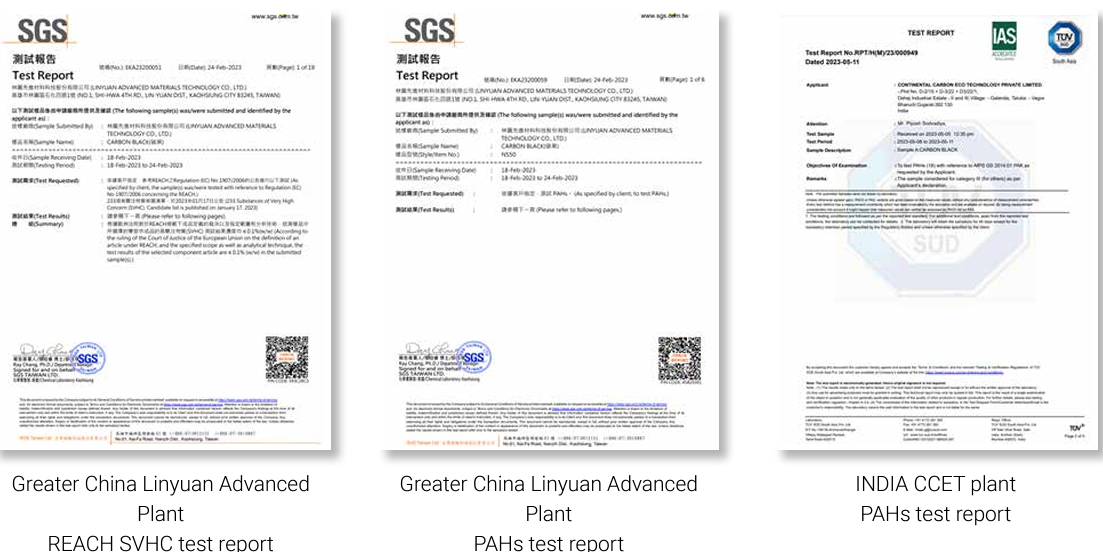
Rubber and plastic (such as ABS and PP) and transparent paints and coatings on natural materials may contain highly hazardous materials such as polycyclic aromatic hydrocarbons (PAHs). In addition, studies have shown that PAHs are most harmful to the human skin and respiratory tract. As persistent organic pollutants, they have been listed as carcinogens by the International Cancer Research Center. In view of this, we are committed to reducing the content of PAHs in carbon black, complying with the second-category requirements of German Safety (GS) standards as issued by Germany's Product Safety Commission (AfPS), and conducting annual tests for PAH limits and content in carbon black, thereby allowing customers to purchase and use our products with peace of mind. In 2024, the Linyuan Advanced Plant in the Greater China region passed 264 hazardous substance tests; the six carbon black products in the U.S. region each passed 17 tests related to Polycyclic Aromatic Hydrocarbons (PAHs) and extractable substances, totaling 102 tests; the CCET plant in India passed 240 substances compliant with SVHC (Substances of Very High Concern) and 30 substances compliant with RoHS (Restriction of Hazardous Substances) tests. Meanwhile, the CCIPL plant passed 228 substances compliant with SVHC and 30 substances compliant with RoHS, with a product pass rate of 100% for all tests.
Applications of Non-Toxic Carbon Black Series products
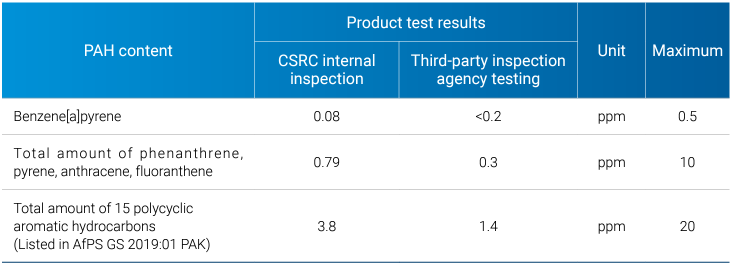
Limits and verification of polycyclic aromatic hydrocarbons in carbon black
| PAH content | Product test results | Unit | Maximum | |
|---|---|---|---|---|
| CSRC internal inspection | Third-party inspection agency testing | |||
| Benzene[a]pyrene | <0.2 | <0.2 | ppm | 0.5 |
| Total amount of phenanthrene, pyrene, anthracene, fluoranthene | 1.5 | 0.7 | ppm | 10 |
| Total amount of 15 polycyclic aromatic hydrocarbons | 3.0 | 2.4 | ppm | 20 |
| Note 1 | CSRC uses an internally developed PAHs rapid screening method to measure the content of 15 or 18 PAHs. This method is applied at various stages, including during production, after packaging, and before shipment. Additionally, third-party testing agencies are periodically engaged to obtain reports. |
| Note 2 | The hazardous substance (specific chemicals) testing conducted in carbon black production is monitored through photro (toluene translucency), with testing frequency occurring every four or eight hours. |
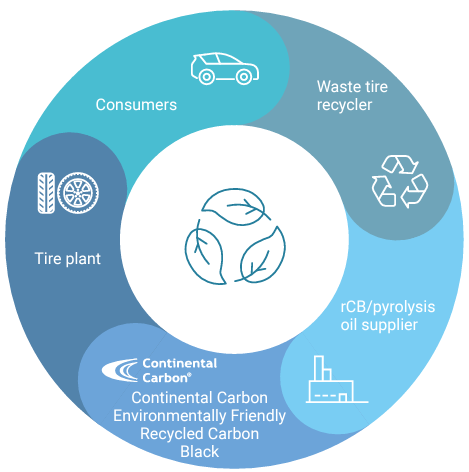
In response to the global net zero emissions trend, we are further introducing the "New Circular Economy Model." Starting from raw materials, we collaborate with waste tire recycling and pyrolysis plant operators to utilize recycled carbon black and pyrolysis oil. Through R&D technology adjustments in carbon black formulation and processes, we produce new " Eco-circular carbon black." This not only meets the tire and rubber industry's demand for sustainable raw materials, but also achieves a closed-loop system for carbon black, thereby achieving the goal of reducing carbon emissions.
The Company continues to invest in R&D to explore various sustainable/renewable materials and energy sources, optimize production processes, improve energy utilization efficiency, and produce stable highquality " Eco-circular carbon black " suitable for different requirements. Through rigorous quality control, in addition to ensuring tire quality remains unaffected when using low-carbon products, advanced production and blending technologies ensure the physical properties of Eco-circular carbon black match those of virgin carbon black, reducing variability in tire rubber formulations. To meet customer carbon reduction goals, we collaborate with the development needs of downstream tire customers to develop products that meet circular economy requirements and achieve carbon reduction.
In response to international customers' emphasis on product environmental protection and carbon reduction, CSRC actively develops new grades of low-carbon and environmentally friendly carbon black products. The Linyuan Advanced Plant in Greater China obtained carbon black carbon footprint certification in 2022, assisting end customers in meeting green requirements.
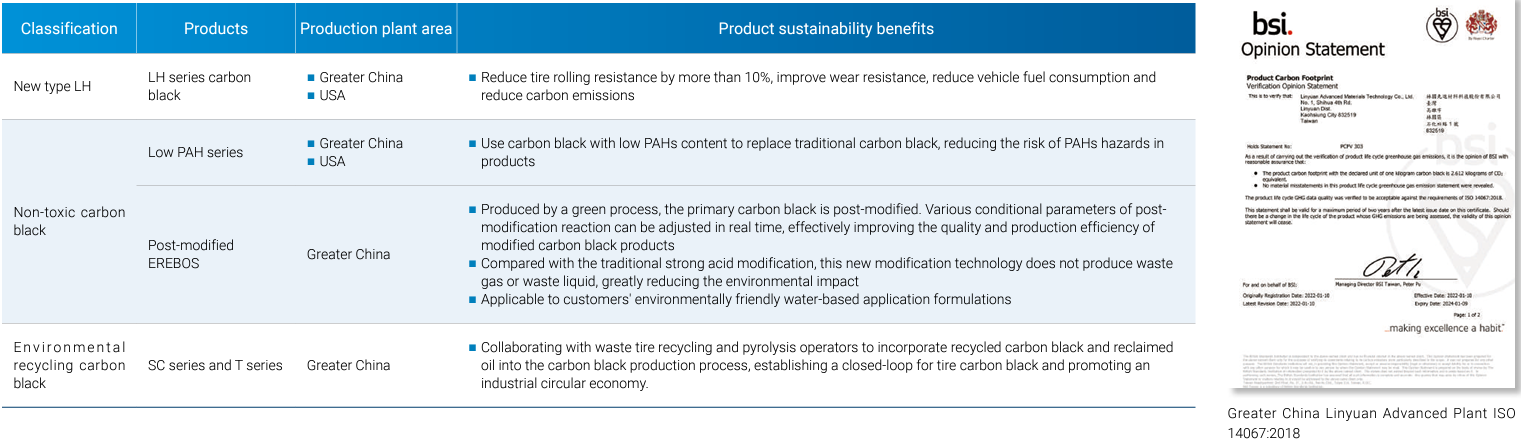
| Classification | Products | Production plant area | Product sustainability benefits |
|---|---|---|---|
| New LH Carbon Black | LH series carbon black |
|
|
| Non-toxic carbon black | Low PAH series |
|
|
| Post-modified EREBOS series | Greater China |
|
|
| Eco-circular carbon black | CC series and T series | Greater China |
|
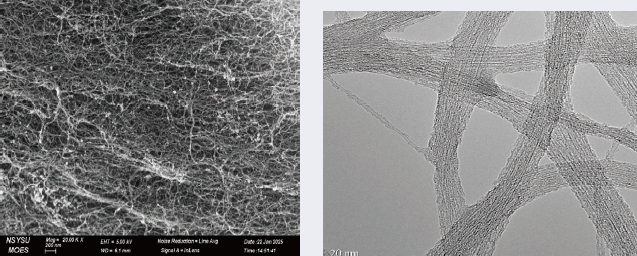
In 2024, single-wall carbon nanotubes (SWCNTs) were successfully developed. Under SEM, dense bundles of carbon nanotubes were observed, while TEM confirmed the single-layer nanotube structure, demonstrating the advantage of a high aspect ratio. Additionally, the carbon nanotubes exhibited excellent quality, with an IG/ID ratio greater than 30 in Raman analysis. Furthermore, the processes for purifying the carbon nanotubes and preparing carbon nanotube suspensions were established, with production scaling up from laboratory-level to pilot production line levels.