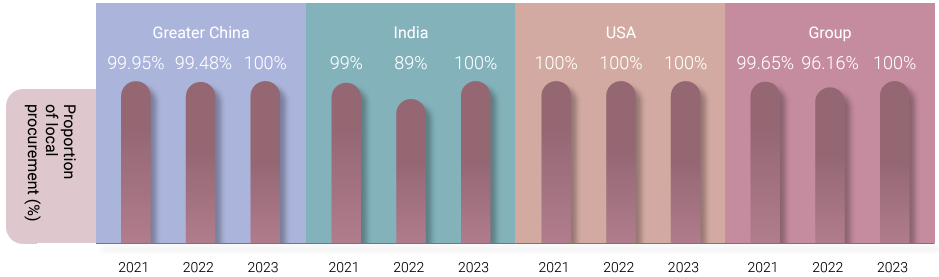
Adhering to the principle of local development and local sourcing, CSRC actively cultivates local suppliers and implements local procurement to ensure timely and appropriate purchasing. This approach reduces management and operational costs while lowering indirect greenhouse gas emissions from international transportation. Additionally, it helps create local jobs and promotes economic prosperity. It also enables better monitoring of raw material supply and reduces operational risks, contributing to more stable production. In 2024, due to the company’s implementation of a unified procurement policy aimed at optimizing the supply chain and reducing costs, the procurement strategy was adjusted, resulting in a significant increase in purchases from non-local suppliers. Compared to the past, when reliance was mainly on local suppliers, the unified procurement policy expanded the supplier base and increased the proportion of non-local suppliers to meet the company’s demands for efficiency, quality, and cost. All of CSRC’s plants purchased 87.74% from local manufacturers in 2024.
Proportion of local procurement by region in the past three years
CSRC actively promotes a green procurement program, prioritizing the purchase of three categories of environmentally friendly products specified by the EPA's "Regulations Governing Procurement of Environmental Protection Products by Government Agencies," aiming to reduce environmental impact, resource consumption, and promote green product manufacturing. Key procurement items include LED lights and energy-saving equipment. The total green procurement amount for 2024 was approximately NT$1,852,468.
| Greater China | India | USA | Group | |
|---|---|---|---|---|
| LED lights | 1,152,784 | 2,964 | - | 1,155,748 |
| Energy-saving equipment | 696,720 | - | - | 696,720 |
| Total | 1,849,504 | 2,964 | - | 1,852,468 |