CSRC’s corporate governance organization structure is represented by the Board of Directors as the Company’s business executive authority. We also establish an Audit Committee to perform supervision and establish a Remuneration Committee that is responsible for formulating, reviewing, and evaluating directors, managers and other salary and remuneration related policies. At the same time, the Audit Committee and the Remuneration Committee have also formulated the organizational rules for compliance for these two respective Committees. Furthermore, to thoroughly implement corporate sustainability actions, in 2018 CSRC established the Measures for the Establishment of the Corporate Sustainability Committee. In December 2023, the Board of Directors resolved to elevate the Corporate Sustainability Committee to the level of a functional committee, thereby actively promoting the implementation of corporate sustainability, ethical corporate management, and social responsibility.

Composition of the Board of Directors
According to CSRC's Articles of Incorporation, the number of directors ranges from 7 to 11, with a term of 3 years. Chairman Jason Koo also serves as the Group CEO. CSRC Group comprises 25 companies, including 24 subsidiaries. As a holding company, unlike typical listed companies, each subsidiary has its own characteristics in terms of operating projects. The Chairman reports to the Board of Directors and is responsible for business management, major decisions, and promoting corporate sustainability. The Group CEO manages all affairs of the related companies, executes board resolutions, and supervises the managers of the Company and its affiliates, differing from the role of the President of the Company and therefore avoiding any conflict of interest.
The election of directors shall adopt the candidate nomination system in accordance with Article 192-1 of the Company Act, and the shareholders' meeting shall elect directors from the list of director candidates. Directors may be re-elected. In 2024, CSRC had a total of 9 directors, of which 4 are independent directors, accounting for 44%, which exceeds the statutory requirement of one-third. The board includes 1 female director; 6 directors (66.67%) are over 51 years old, and 3 directors (33.33%) are between 41-50 years old. The proportion of directors who are employees is 11.11%.
The 19th Board of Directors of the Company emphasizes diversity, comprising elites from industry and academia. Their industrial experience covers finance, business, investment and mergers and acquisitions, risk management, operations management and other capabilities. They possess expertise in management, international markets, risk management, accounting and financial analysis, law, and ESG and other professional capabilities. Distinguished directors include Jason Koo, Lin Nan-Chou, Chang Chi-Wen, Chang Liang, and Ting Yuan-Wei, who have extensive industrial knowledge; directors Yeh Kuo-Hung and Chia Tze-Nan, who have financial accounting experience; director Liu Feng-Ping, who has extensive management and ESG capabilities and director Hsiao Yu-Chieh, who has legal experience. The Company continues to arrange various advanced training courses for board members to enhance their decision-making quality and supervisory capabilities, and thus strengthen the functions of the Board of Directors. Furthermore, CSRC is committed to promoting diversity and inclusion within its Board of Directors, firmly believing that female directors can bring unique perspectives and expertise to the board, thereby enhancing the comprehensiveness and innovativeness of decision-making. At the shareholders' meeting on May 28, 2024, a complete re-election of the board of directors was conducted. The number of directors increased from 8 to 9, with the addition of one female director.
Introduction of Board Members、 Board Diversity
| Position | Name | Gender | Age | Independent director tenure |
|---|---|---|---|---|
| Chairman | Taiwan Cement Corporation representative: Jason Koo | Male | 41–50 years old | - |
| Director | Taiwan Cement Corporation representative: Yeh Kuo-Hung | Male | 41–50 years old | - |
| Director | Hsin Chang Investment Co., Ltd.: Liu Feng-Ping | Female | 51–60 years old | - |
| Director | Chang Chi-Wen | Male | 61-70 years old | - |
| Director | Pei Yang Co., Ltd.: Lin Nan-Chou | Male | 51-60 years old | - |
| Independent Director | Chia Tze-Nan | Male | 71 years old and over | 3-6 years |
| Independent Director | Chang Liang | Male | 71 years old and over | 3-6 years |
| Independent Director | Ting Yuan-Wei | Male | 51–60 years old | 3-6 years |
| Independent Director | Hsiao Yu-Chieh | Male | 41-50 years old | Under 3 years |
Board operation
In 2024, CSRC convened a total of eight board meetingsNote, with an average director attendance rate of 96%, complying with the requirement that meetings of the Board of Directors should be held at least once every quarter. Important proposals are disclosed in the shareholder meeting annual report or on the company's website, ensuring transparent and accurate information disclosure. Directors listen to management team reports during Board meetings, and offer guidance and advice while maintaining good communication with the management team. Together, they work to create maximum benefits for shareholders. The remuneration of directors is determined based on their participation in the Company's operations, their contribution value, and the evaluation of compensation levels in the domestic and international industry. The operation of the Board of Directors is based on the indicators of the Corporate Governance Evaluation System. At the same time, it complies with corporate governance standards. As of the end of 2024, all independent directors comply with the regulations concerning independent directors set by the Securities and Futures Bureau of the Financial Supervisory Commission, and there are no circumstances as specified in Article 26-3, Paragraphs 3 and 4 of the Securities and Exchange Act between any directors and independent directors. The Board of Directors of the Company maintains its independence.
Board of Directors Meeting Practices
Avoidance of conflicts of interest
The powers of the Board of Directors include business planning, profit distribution, capital increase and decrease, important rules and contract approval, appointment and removal of the President, branch establishment and abolition, budget and final accounts review, real estate trading, investments and other business review, and other important matters. The operation of the Board of Directors does abide by the rules of the Board of Directors and relevant laws and regulations. It supervises and understands Company operations and various existing or potential risks for the Company. It maintains good and timely interaction with management to fully leverage the functions of the Board of Directors.
In respect to meeting matters, if a director or the juristic person represented thereby has a stake in a proposal at the meeting, that director shall state the important aspects of the stake in the meeting, and where there is a likelihood that the interests of the Company would be harmed, shall recuse themselves from any discussion and voting, and may not exercise voting rights as proxy on behalf of another director. For more details on directors' recusal from conflicted-interest matters, please refer to page 27 of the 2024 Annual Report of the shareholders’ meeting.
Management Remuneration Policy
The remuneration policy for the President and managers is presented to the Remuneration Committee with reasonable recommendations based on the Company's operational performance, profitability, personal performance and salary market standards etc., before the Board’s approval.
Compensation includes quarterly and year-end bonus. Evaluations cover financial performance, including corporate governance, social care and environmental sustainability. By linking compensation with long-term operations, the goal of sustainable management can be achieved.
| For more corporate governance practices of CSRC, please refer to: | ||

Official website
|

Implementation of Board diversity policy of CSRC
|

Procedures for election of directors of CSRC
|
Board of Directors Training
CSRC continually arranges a variety of training courses for board members, irregularly providing information on external courses. In 2024, the Company hosted three in-house training sessions: "The Path to Net-Zero Just Transition for Taiwan’s Hard-to-Abate Sectors, "Sustainability Financial Disclosure," and "Corporate Governance and Compliance – Insider Trading and Collusive Practices." Expert instructors were invited to deliver these sessions to directors and senior managers. This effort aims to continually enhance the diverse expertise of the directors, strengthen their supervisory capabilities, and thereby enhance the board’s functionality and collective intelligence in sustainable development.

CSRC prioritizes ESG sustainability. To enhance directors’ in-depth understanding of various issues, the company conducted training courses in 2024, including: The Path to Net-Zero Just Transition for Taiwan’s Hard-to-Abate Sectors, Sustainability Financial Disclosure, Trends and Risk Management in Digital Technology and Artificial Intelligence, and Director and Supervisor Risks and Corporate Opportunities in Implementing ESG Sustainability. These courses totaled 54 hours, equipping directors with the knowledge to lead the company’s future development amidst rapidly changing environments.
Board of Directors Performance Evaluation
To implement corporate governance and enhance the functionality of the Board of Directors, the Company has established the Board of Directors Performance Evaluation Measures, conducting evaluations annually. The scope of the board performance evaluation includes the entire Board of Directors and individual director members. In addition to the internal selfassessment conducted annually in accordance with the law and the Company’s Board of Directors Performance Evaluation Measures, the external evaluation, which was previously conducted every three years, has been conducted annually since 2023. External experts are engaged to carry out the performance evaluation to strengthen corporate governance and enhance the functioning of the Board of Directors. The results of the internal and external performance evaluations of the Board of Directors shall be completed before the end of the first quarter of the following year. Please refer to the Board of Directors Performance Evaluation Report for 2024 for internal and external Note performance evaluation results.
In addition, the Company and its subsidiaries have purchased “Directors and Officers Liability Insurance” for directors, supervisors, and key executives to cover their indemnity obligations during their terms of office. The insurance policy contents are reviewed annually to reduce the risks borne by directors, supervisors, key executives, and the Company, and to establish and enhance the corporate governance mechanism.
Note An external professional independent organization evaluated the operations and performance of the company's Board of Directors for the 2024 period (January 1, 2024, to December 31, 2024). The evaluation report was issued before February 28, 2025, and presented at the Board of Directors meeting on March 11, 2025.

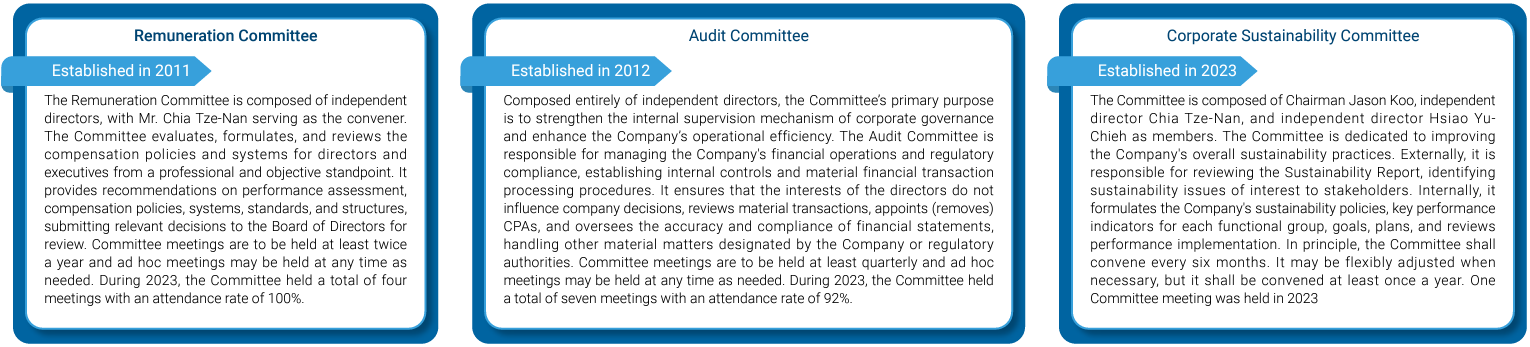
The Remuneration Committee is composed of independent directors, with Mr. Chia Tze-Nan serving as the convener. The Committee evaluates, formulates, and reviews the compensation policies and systems for directors and executives from a professional and objective standpoint. It provides recommendations on performance assessment, compensation policies, systems, standards, and structures, submitting relevant decisions to the Board of Directors for review. Committee meetings are to be held at least twice a year and ad hoc meetings may be held at any time as needed. During 2024, the Committee held a total of four meetings with an attendance rate of 100%.
Composed entirely of independent directors, the Committee’s primary purpose is to strengthen the internal supervision mechanism of corporate governance and enhance the Company’s operational efficiency. The Audit Committee is responsible for managing the Company's financial operations and regulatory compliance, establishing internal controls and key financial transaction processing procedures. It ensures that the interests of the directors do not influence company decisions, reviews material transactions, appoints (removes) CPAs, and oversees the accuracy and compliance of financial statements, handling other major matters designated by the Company or regulatory authorities. Committee meetings are to be held at least quarterly and ad hoc meetings may be held at any time as needed. During 2024, the Committee held a total of eight meetings with an attendance rate of 95%.
The Committee is composed of Chairman Jason Koo, independent director Chia Tze-Nan, and independent director Hsiao Yu-Chieh as members. The Committee is dedicated to improving the Company's overall sustainability practices. Externally, it is responsible for reviewing the Sustainability Report, identifying sustainability issues of interest to stakeholders. Internally, it formulates the Company's sustainability policies, key performance indicators for each functional group, goals, plans, and reviews performance implementation. In principle, the Committee shall convene every six months. It may be flexibly adjusted when necessary, but it shall be convened at least once a year. In 2024, the committee convened twice, with a 100% attendance rate.
Composition of the Internal Audit Unit
CSRC’s internal audit is an independent unit directly under the Board of Directors. In addition to reporting to the Board of Directors, it reports to the Chairman and to the Audit Committee quarterly or when necessary. The auditors are all full-time personnel, including one audit supervisor and one auditor. All are qualified as a Certified Internal Auditor. Appointment and removal of internal auditors is done according to relevant laws and regulations and approved by the Audit Committee and submitted for resolution of the Board of Directors.
The evaluation and salary remuneration of internal auditors are regularly evaluated in accordance with the Measures for Appointment, Removal, Evaluation, and Salary and Remuneration of Internal Auditors, the Performance Management Measures, and the Salary Measures approved by the Company's Board of Directors on May 11, 2021. The Audit Supervisor shall sign and report to the Chairman of the Board for approval.
Main duties of the Internal Audit Unit
After the audit has undergone risk assessment, the priority of the audit targets and audit items is determined according to the level of risk, and the annual audit plan is formulated. After approval by the Board of Directors and the Audit Committee, then according to the provisions of Financial Supervisory Commission, it shall be submitted for inspection by Financial Supervisory Commission through the Internet information system before the end of December each year. The audit team shall implement internal audit operations according to the annual audit plan, compose internal audit proposals, and submit audit reports. After the audit report is approved by the Chairman, the units being audited will be notified to improve within a set period of time. Improvement of abnormal matters specified in the internal audit shall be tracked and an internal audit tracking report will be prepared according to the improvement measures developed by the units being audited. After its approval by the Chairman, an "Annual Internal Audit Abnormality Improvement Report" will be prepared and disclosed in the Market Observation Post System before end of May every year and reported to Financial Supervisory Commission for future reference. For a summary of the relevant audit and tracking reports of 2024, please refer to the explanation under 1.5.2 Risk Identification and Early Warning Process.
The Audit Office is responsible for handling matters concerning the self-assessment of the Company’s internal control system, reviewing the self-assessment report of the internal control system of each unit and subsidiary of the Company and assisting and supervising the implementation of the internal control system of each subsidiary.
The audit supervisor attends the entire Board of Directors and audit committee every quarter. They carry out the business report of the audit office, explaining the audit findings of each inspected unit and the follow-up improvement status. During meetings of the Audit Committee and the Board of Directors, independent directors may provide comments on the content of the audit report, and it will be explained by the audit supervisor. For the approval of the annual audit plan, when the audit office drafts the annual audit plan it will also check the audit key points after the risk assessment. It will list the items to be audited each month in detail, and make detailed explanation to the Audit Committee and the Board of Directors, and it shall be approved by the Audit Committee and the Board of Directors. It is expected that the internal audit operations will meet the needs of corporate governance. In addition to meetings for communication, audit supervisors, accountants and independent directors also directly contact and communicate with each other as needed at any time, maintaining a good interactive relationship.
In the Corporate Social Responsibility Best Practice Principles, CSRC clearly stipulates that when performing corporate social responsibilities, it should respect social ethics and pay attention to the rights and interests of other stakeholders. While pursuing sustainable operation and profitability, it also attaches importance to environmental, social and corporate governance factors and incorporates them into the Company’s management and operation policies. In terms of shareholders’ equity, it sets up a dedicated person in charge of investor relations, The spokesperson and investor relations officer accept shareholder suggestions and concerns and handle disputes. Relevant departments will accept suggestions and handle disputes according to the type of problem.
Creating the highest interests for shareholders is the goal of CSRC and all colleagues. In order to maintain good communication channels with investors and disclose information to shareholders, the Company’s operations and financial conditions are reported to investors in addition to the regularly-convened annual shareholder meetings, investor conferences, and interim institutional investor meetings. We have established an “Investor Area” on the Company’s official website, and use financial information, corporate governance, and shareholder columns to publish relevant financial statements, investor conference information, internal audits, Company regulations, dividend distributions over the years, important information announcements, and so on. We publish the information in the fastest way to provide it to investors for reference.